Tell us about the job
Takes about a minute. No obligation.
A contractor quoting a water heater replacement in York County starts by confirming the fuel source, because that single fact decides what equipment is eligible and how it has to be vented. Fuel oil or kerosene heats more occupied homes in York County, Maine than any other fuel, at 60.5% (2020-2024 ACS 5-year). That share of oil-fired homes means most replacements involve a flue, draft hood, and combustion air path that a new unit must match or the install fails inspection. Switching fuel types is an option only if the house has an existing gas line or the homeowner adds one, so the fuel question shapes the whole project before any equipment gets priced.
Ductwork laid out for an older system carries assumptions about airflow, routing, and load that a replacement unit does not share. Half the homes in York County, Maine were built in 1980 or earlier (2020-2024 ACS 5-year). A contractor installing a new water heater in stock like this has to assess what the existing runs will and will not do before the equipment decision is made, because the layout may force a reroute, an upsizing, or a workaround the quote has to account for. The ductwork, in this county, is where the job gets defined.
What Gets Installed With a New Water Heater
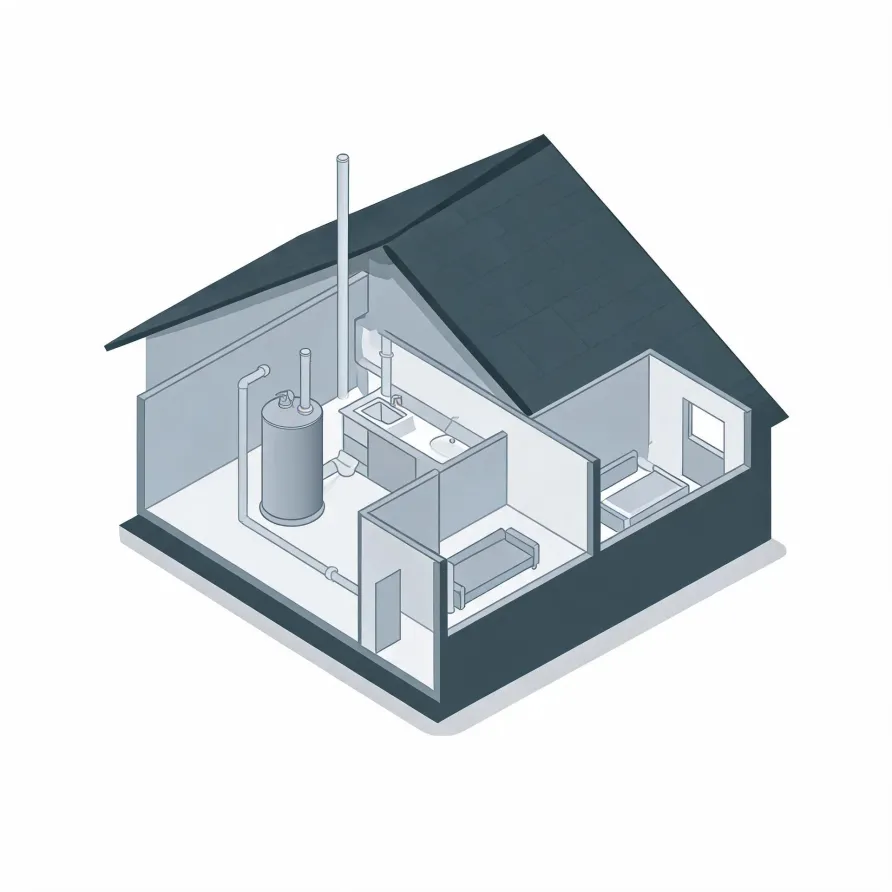
The tank is the centerpiece of the installation. It sits in a utility room, basement, or closet and holds a supply of water that a heating element or burner inside the unit keeps at a set temperature. On a tankless unit, that same heating work happens in a wall-mounted cabinet with no stored water at all.
A pressure relief valve mounts directly to the tank and is the safety device the installation puts in place to handle excess pressure. The cold supply line feeds into the unit from above or the side, and the hot outlet line carries heated water out to the rest of the house. A drain valve sits near the base of the tank.
The drawing shows a representative layout, and a licensed contractor determines exactly what the installation involves in your house.
Find a contractor in York CountyYork County, Maine, by the numbers
209 severe weather events were recorded in York County, Maine between 2015 and 2024.
NOAA National Centers for Environmental Information, Storm Events Database, bulk CSV export, events 2015-01-01 through 2024-12-31.Half the homes in York County, Maine were built in 1980 or earlier (2020-2024 ACS 5-year).
U.S. Census Bureau, 2020-2024 American Community Survey 5-Year EstimatesYork County, Maine holds 115,091 housing units (2020-2024 ACS 5-year).
U.S. Census Bureau, 2020-2024 American Community Survey 5-Year EstimatesOwners occupy 77.3% of the occupied homes in York County, Maine (2020-2024 ACS 5-year).
U.S. Census Bureau, 2020-2024 American Community Survey 5-Year EstimatesSevere Weather in York County
Water heaters work harder when outdoor conditions swing hard, and in Maine those swings are part of what sizing and installation decisions have to account for. What happens in York County is a local variable, and the record below reflects it.
209 severe weather events, 2015–2024. Source: NOAA National Centers for Environmental Information, Storm Events Database.