Tell us about the job
Takes about a minute. No obligation.
Fuel oil and kerosene water heaters run on combustion, and the burner assembly, nozzle, and heat exchanger take the full load of every firing cycle the unit completes. Fuel oil or kerosene heats more occupied homes in Piscataquis County, Maine than any other fuel, at 54.4% (2020-2024 ACS 5-year). A contractor called out for a no-heat or poor-recovery complaint on an oil-fired unit checks the nozzle first, because a clogged or degraded nozzle produces incomplete combustion that stresses the heat exchanger before it ever shows up as a visible fault. Soot buildup on the exchanger surface cuts transfer efficiency and forces the burner to fire longer to reach the same output, which accelerates wear on the igniter and electrodes. Those are the parts that give out first on a unit running this fuel.
The plumbing that feeds a water heater in a house here often tells a harder story than the heater does. Half the homes in Piscataquis County, Maine were built in 1978 or earlier (2020-2024 ACS 5-year). A contractor who opens a unit and finds a failed element or a corroded anode rod still has to account for what the supply lines, shutoffs, and connections around it look like after decades of mineral-heavy Maine water and seasonal temperature swings. Sediment in the tank and scale on the fittings are what extend a repair or change its scope, and in stock this old that is where the job tends to go.
The Parts of a Water Heater a Contractor Checks First
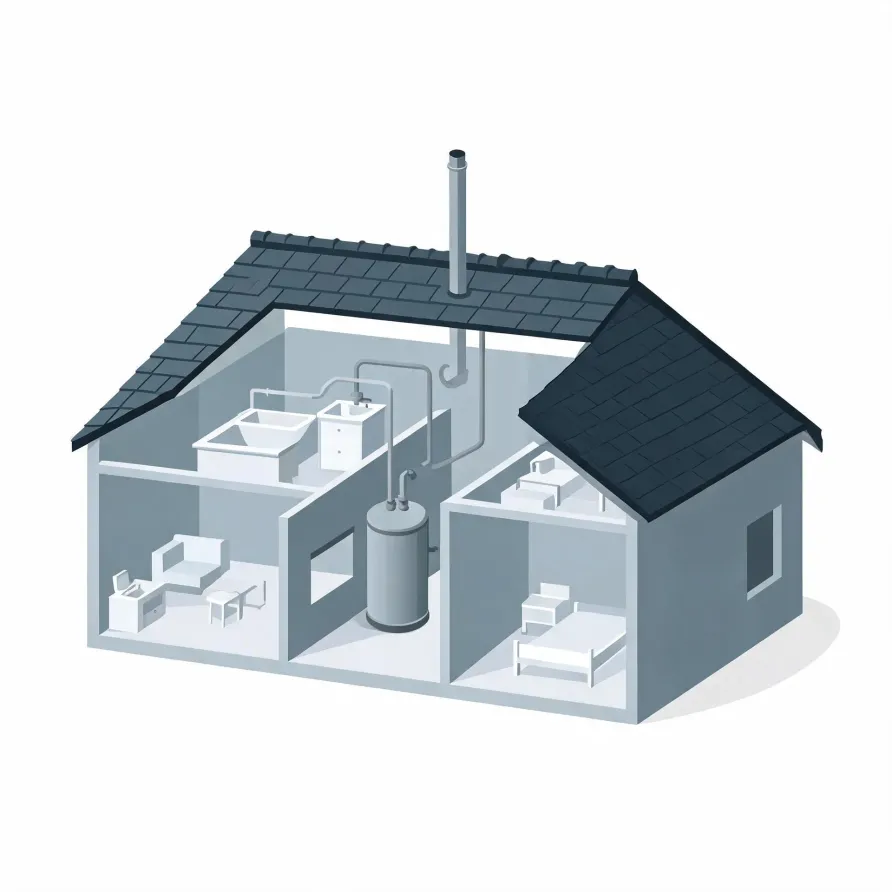
The tank is what most homeowners notice: a tall insulated cylinder that sits in a utility room, basement, or closet and holds a standing supply of hot water. The burner assembly or heating element sits at the base or inside the tank and is the first thing a contractor looks at when the water runs cold or never gets hot.
The thermostat controls the target temperature and is mounted on the outside of the tank or submerged inside it depending on the unit type. The pressure relief valve, the anode rod, and the cold-water inlet and hot-water outlet connections are each points a contractor examines when diagnosing leaks, pressure problems, or corrosion.
The drawing shows a general layout, and a licensed contractor determines what applies to the specific unit and installation in your home.
Find a contractor in Piscataquis CountyPiscataquis County by the numbers
227 severe weather events were recorded in Piscataquis County, Maine between 2015 and 2024.
NOAA National Centers for Environmental Information, Storm Events Database, bulk CSV export, events 2015-01-01 through 2024-12-31.Half the homes in Piscataquis County, Maine were built in 1978 or earlier (2020-2024 ACS 5-year).
U.S. Census Bureau, 2020-2024 American Community Survey 5-Year EstimatesPiscataquis County, Maine holds 14,680 housing units (2020-2024 ACS 5-year).
U.S. Census Bureau, 2020-2024 American Community Survey 5-Year EstimatesOwners occupy 78.8% of the occupied homes in Piscataquis County, Maine (2020-2024 ACS 5-year).
U.S. Census Bureau, 2020-2024 American Community Survey 5-Year EstimatesSevere Weather Events in Piscataquis County
Extreme weather puts real load on water heating equipment, from power fluctuations that stress components to temperature swings that force systems to work harder and longer. How much of that pressure a unit in Piscataquis County faces is a local question, and the record below gives that context.
227 severe weather events, 2015–2024. Source: NOAA National Centers for Environmental Information, Storm Events Database.